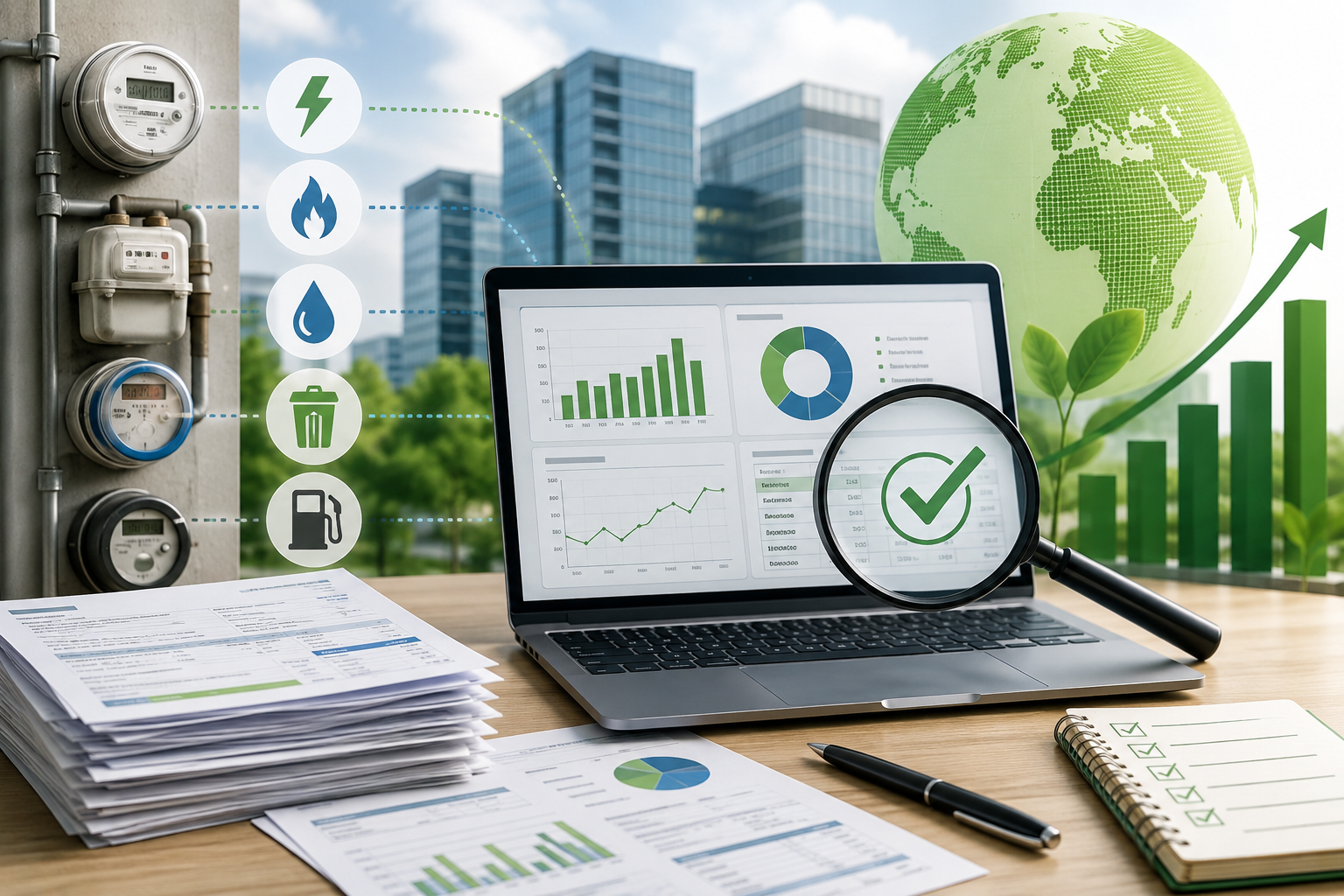
Benchmarking one building is a task. Benchmarking fifty or more buildings is an operating system…
What CFOs Need to Know About Environmental Reporting
Environmental reporting is no longer just a sustainability team concern. For CFOs, it is becoming a finance, risk, operations, and customer retention issue.
That shift matters. When environmental data is incomplete, scattered, or difficult to verify, the problem does not stay neatly inside an environmental report. It can affect procurement conversations, investor questions, operating costs, compliance readiness, and the credibility of business decisions.
For most companies, especially organizations with multiple properties, utility-intensive operations, or customers asking tougher questions about sustainability, environmental reporting should be treated as business infrastructure. The goal is not to create a prettier report. The goal is to build a reliable system for turning environmental data into decisions.
Why CFOs are being pulled into environmental reporting
Historically, environmental reporting often lived with facilities, operations, sustainability, or compliance teams. Finance might have reviewed the final numbers, but the day-to-day process happened elsewhere.
That model is getting harder to maintain.
CFOs are increasingly involved because environmental reporting touches core financial responsibilities:
- Risk management: Inaccurate or incomplete emissions data can create exposure when customers, regulators, investors, or partners ask for documentation.
- Cost control: Utility data can reveal waste, leaks, inefficiencies, and avoidable operating expenses.
- Forecasting: Energy, water, fuel, and waste costs affect budgets and long-term planning.
- Procurement: Larger customers may request sustainability information before awarding contracts or renewing vendor relationships.
- Capital planning: Efficiency upgrades often require financial justification, prioritization, and measurement.
- Investor and lender communication: Environmental performance is increasingly part of the broader story of operational discipline.
- In short, environmental data is becoming financial data. CFOs do not need to own every detail of sustainability work, but they do need confidence that the underlying numbers are accurate, accessible, and decision-ready.
The hidden problem: environmental data is usually messy
The biggest challenge is rarely a lack of intent. Most organizations want better reporting. The problem is that environmental data often lives in too many places.
Utility bills may be stored as PDFs. Meter data may sit with property managers. Waste data may come from vendors. Fuel use may be tracked separately. Emissions calculations may happen in spreadsheets. Different teams may define categories differently.
That creates several problems:
- Reports take too long to assemble.
- Teams spend time cleaning data instead of analyzing it.
- Numbers are hard to verify.
- Errors can carry forward from one reporting cycle to the next.
- Finance leaders may not know which numbers are reliable.
- Operational opportunities stay hidden.
For a CFO, this should look familiar. It is the same problem finance teams face whenever business-critical data lacks a clean system of record.
If environmental reporting depends on manual collection, scattered files, and one-off analysis, the organization is not really building reporting capability. It is rebuilding the same report again and again.
Why emissions reporting is a business risk issue
Terms like ESG, GHG emissions, and Scope 1, 2, and 3 reporting can sound technical. But the business issue is straightforward: stakeholders increasingly want to know the environmental impact of the organizations they buy from, invest in, partner with, or regulate.
For CFOs, the concern is not only whether the company can produce a report. The concern is whether the company can stand behind the report.
That requires better data quality.
If a customer asks for emissions information during procurement, can the team respond quickly? If an investor asks how utility consumption is changing across properties, can finance answer with confidence? If local reporting requirements become more relevant to the business, is the company ready? If leadership wants to invest in efficiency upgrades, can the team identify which properties or systems deserve priority?
Weak environmental data creates uncertainty. Strong environmental data creates options.
Environmental reporting can reveal operating savings
There is another reason CFOs should care: environmental reporting is not only about external disclosure. It can uncover internal savings.
Utility data can point to leaks, abnormal usage, inefficient equipment, poor building performance, or changes in operating behavior. Water, electricity, natural gas, waste, and fuel data all tell a story about how the organization actually runs.
When that data is tracked consistently, companies can ask better questions:
- Which properties are using more energy than expected?
- Are water costs rising because of rates, usage, leaks, or operations?
- Which facilities have the strongest case for efficiency upgrades?
- Are improvements showing up in measurable results?
- Where are utility costs creating avoidable margin pressure?
- Which trends should be included in next year’s budget?
This is where environmental reporting becomes more than compliance. It becomes a source of operational intelligence.
For CFOs, the value is not just “we reported our emissions.” The value is “we found better information to manage cost, risk, and performance.”
The CFO lens: what good environmental reporting should provide
A useful environmental reporting system should help finance leaders answer practical business questions. At minimum, CFOs should look for five capabilities.
1. Data that can be trusted
The reporting process should reduce manual rework and make the source of each number easier to understand. If the team cannot explain where the data came from, how it was categorized, and how it was calculated, the report becomes harder to defend.
2. Visibility across properties and utilities
For organizations with multiple locations, aggregate numbers are not enough. Leaders need to see patterns by property, utility type, time period, and operating context.
3. Reporting that is fast enough to be useful
If reporting takes months to assemble, it becomes a backward-looking exercise. Faster reporting helps teams respond to customer requests, leadership questions, and operational issues while the information is still actionable.
4. Metrics connected to business decisions
Environmental reporting should connect to budgeting, capital planning, procurement, and risk management. The numbers should help leaders decide where to invest, what to fix, and what to prioritize.
5. A repeatable workflow
The process should get easier over time. If every reporting cycle starts from scratch, the organization has not solved the underlying problem.
What CFOs should do next
CFOs do not need to become sustainability specialists. But they should ask sharper questions about the company’s environmental data.
Start with these:
- Where does our utility and emissions data live today?
- Who owns each part of the reporting process?
- How much manual work is required to produce a report?
- Which numbers would we feel comfortable sharing with a customer, investor, or regulator?
- Can we see utility trends by property or business unit?
- Are we using environmental data to identify savings opportunities?
- What would happen if we needed to answer an ESG or emissions data request this week?
These questions help move environmental reporting from a reactive scramble to a managed business process.
The takeaway
For CFOs, environmental reporting should not be treated as a side project or a branding exercise. It is part of how companies manage risk, protect customer relationships, control costs, and prepare for future reporting expectations.
The organizations that handle this well will not be the ones with the most polished language. They will be the ones with the most reliable data.
Verdafero helps finance and operations teams turn environmental data into decision-ready reporting by tracking utility data, producing emissions-ready reports, and surfacing insights that support better business decisions. We’d be happy to provide a demo for you, just visit www.verdafero.com.
Related Posts